What changed
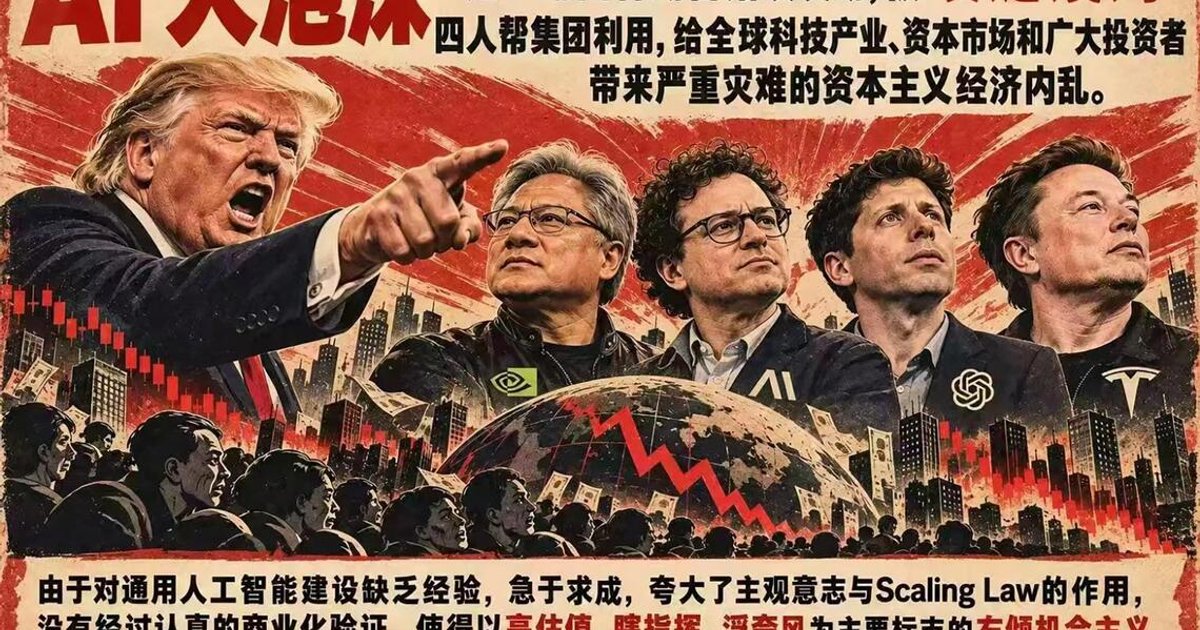
Chinese social-media users are circulating spoofs that recast Donald Trump’s AI push as a Chinese-style political campaign, complete with official-sounding language, Mao-era imagery and warnings about a “Great AI Bubble.”
The jokes target Trump, US AI companies, data centres and executives including Nvidia’s Jensen Huang, Anthropic’s Dario Amodei, OpenAI’s Sam Altman and Tesla’s Elon Musk. One parody even borrows Beijing’s property-sector language, declaring that “data centres are for computing, not speculation” and proposing “three red lines” for AI companies’ borrowing.
Why it matters
The satire lands because it turns China’s own political vocabulary back on America. A spoofed Associated Press report uses the ponderous language of Communist Party campaigns, while another poster casts Trump and four technology leaders as a new “Gang of Four.” Other jokes compare Silicon Valley’s push for more computing power with Mao’s Great Leap Forward, imagining “communes of 10,000 GPUs” and “backyard model training.”
That is more than a punchline. It frames America’s AI expansion as a question of political ambition and infrastructure excess, not just technological progress. The underlying target is the assumption that ever more data centres, chips and investment must automatically produce better results.
The comparison also has an uncomfortable edge for China. The country faces excess data-centre capacity and low use of some computing infrastructure of its own. So the mockery does not establish that China has solved the problem America may be creating. It shows that both systems can recognise the risks of building first and finding a purpose later.
Whether the jokes represent broad Chinese public opinion, or influence US policy and investment, remains uncertain. Their clearest effect is rhetorical: they give Chinese users a familiar political language for laughing at America’s AI ambitions while exposing a vulnerability that exists on both sides of the Pacific.
Comments
No comments yet.