What changed
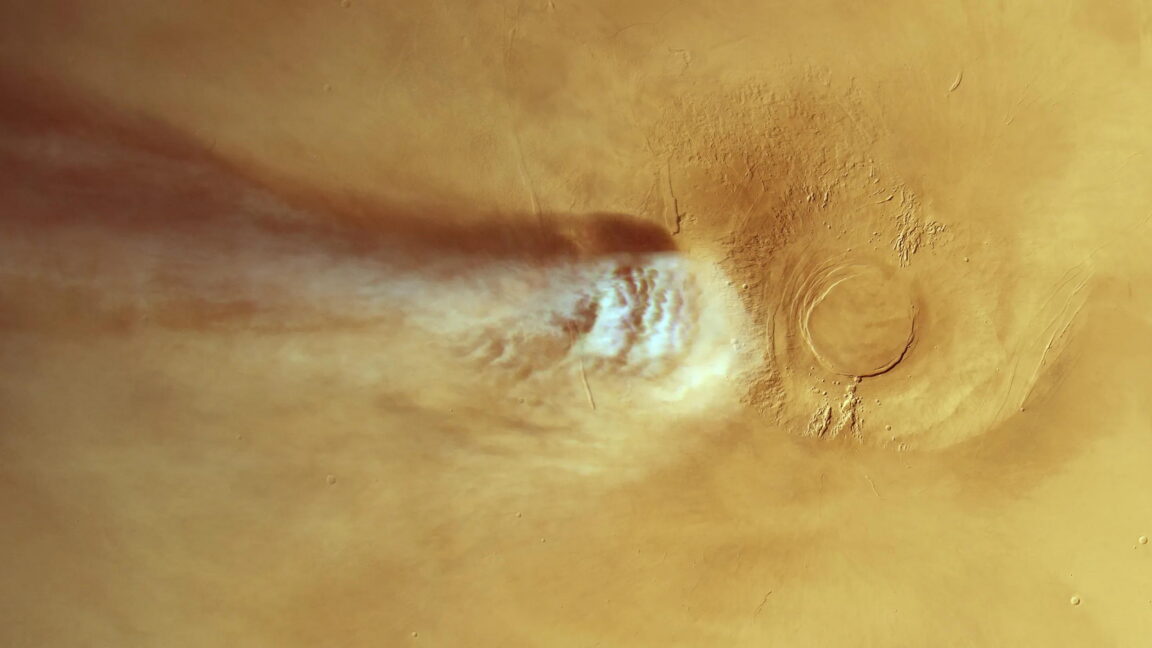
Researchers at Sorbonne Université have modeled the Arsia Mons Elongated Cloud, a recurring Martian formation that appears near the 65,000-foot volcano each spring and summer before stretching beyond 1,000 miles. Their study, published in Nature Geoscience, suggests the cloud forms through homogeneous nucleation: vapor turning directly into ice without dust or other particles.
Why it matters
Mars may be staging a form of cloud-making that has never been directly observed in nature. The proposed mechanism needs a 30°C temperature drop within 10 minutes and humidity more than 100,000 times higher than the greatest value measured on Earth.
Arsia Mons supplies the trigger. Winds striking the volcano can create a powerful wave, lifting moist air high into the atmosphere within minutes. The model implies that this fleeting combination is enough to produce the cloud, which was first recorded by a probe in 2018 and then repeats for months.
That makes the cloud more than an impressive Martian weather pattern. It is a natural experiment in atmospheric physics. The process remains a model rather than a direct observation, but it gives researchers a concrete phenomenon to test as they learn more about Mars’ atmosphere.
Comments
No comments yet.