What changed
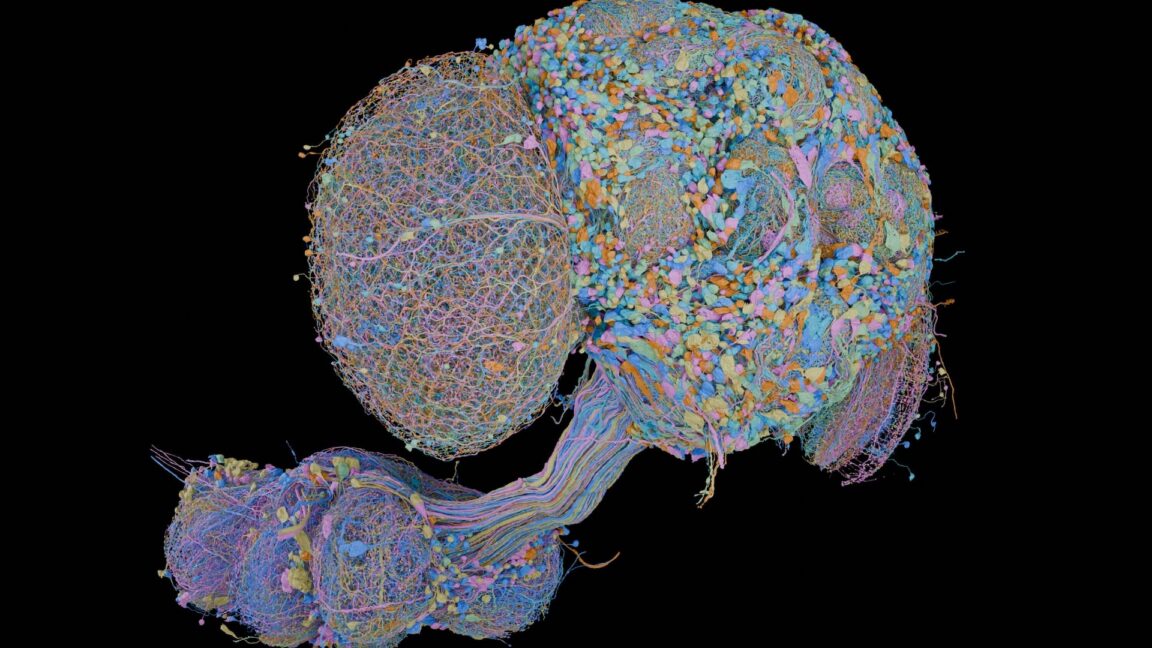
Based on Ars Technica’s reporting, HHMI Janelia Research Campus and Google have completed a map of every neuron in a male fruit fly brain, the second complete fruit-fly connectome after a female map finished earlier in 2026. The reconstruction identifies more than 300 million synaptic connections and records neurons’ three-dimensional locations.
Why This Matters
This is not a smarter fly. It is a much better test bench for understanding how a complex system turns inputs into action.
A single complete map is a reference. Two maps create comparison. That changes the useful question from “what is wired to what?” to “which wiring patterns hold up, and which differ?” For teams building tools around imaging, machine interpretation, or scientific data infrastructure, that is the difference between a heroic one-off dataset and a proving ground for repeatable workflows.
The immediate value is research access, not a near-term product. The larger bet is whether methods that can reconstruct hundreds of millions of synapses in a fly can become practical building blocks for more complex nervous systems. That remains uncertain; bigger brains are not simply flies with extra seats.
Our outlook (informed speculation): the paired maps could make comparative work the first real stress test of the collaboration’s reconstruction workflow. If researchers can use both maps to generate useful circuit-level questions, tool development may shift from finishing one monumental reconstruction toward making the next one less monumental.
How the effects could spread
The male map gives Drosophila researchers a second fully mapped brain for circuit-level comparison. If those comparisons reveal useful patterns or differences, they can direct experiments toward particular connections rather than treating the connectome as an enormous static catalog.
That use would feed back into the tooling. Researchers’ demands for faster or clearer reconstruction could show where image interpretation and computational workflows need refinement. If those refinements transfer beyond the completed fly datasets, laboratories studying more complex nervous systems may gain more practical ways to reconstruct neural connections.
The chain can break in two places: biological differences may not yield broadly useful findings, and the computational or imaging burden may rise too sharply outside the fruit-fly brain.
Impact assessment
- Drosophila neurobiology researchers: Gain a second complete connectome immediately, creating a stronger basis for comparing neural wiring across two mapped brains.
- HHMI Janelia and Google research teams: Gain a completed reconstruction of more than 300 million synaptic connections and a concrete environment for refining their joint methods.
- Vertebrate-neuroscience laboratories: Are exposed to a longer-term opportunity, not a delivered benefit. If the workflow scales, access to reconstruction methods could improve; if it does not, the fly maps remain specialized reference resources.
Scenarios
Most likely: If the male and female maps prove usable for comparative analysis over the next 6–12 months, researchers will use them to target follow-up questions about how wiring relates to brain function. That would push tool teams toward refining reconstruction workflows around the bottlenecks those studies expose. Comparative studies using both maps, and new projects describing the refined methods, would strengthen this path. Sparse comparative use or failed transfer beyond fly datasets would weaken it.
Upside: If comparisons produce reproducible circuit-level patterns that lead to experimentally testable hypotheses, connectome-guided experiments could attract broader research effort. When related workflows also work on more complex nervous systems, reconstruction capacity could become more useful beyond fruit-fly research. Tested hypotheses from the paired maps and successful applications to larger systems would support this outcome; unusable comparative findings or overwhelmed workflows would undercut it.
Downside: Unless the refined methods carry beyond the fruit fly, the male map may remain chiefly a valuable but specialized reference resource. As imaging and computational demands rise, expansion could slow, leaving larger-system laboratories without the anticipated workflow gains. Follow-on work emphasizing annotation or scaling burdens would point this way; independent adoption on larger mapping projects would argue against it.
What to watch next
- Comparative studies that use both the male and female connectomes to examine shared or different circuit organization, expected from weeks through the next 6–12 months.
- Projects from HHMI Janelia, Google, or other connectomics teams applying related imaging-interpretation workflows to more complex nervous systems.
Comments
No comments yet.