What changed
Nvidia expanded its Halos safety architecture from autonomous vehicles to robotics in June 2026. The system combines safety hardware, monitoring software, sensor-data checks, virtual simulation and inspection support for machines including mobile robots, humanoids, industrial robots and surgical robots.
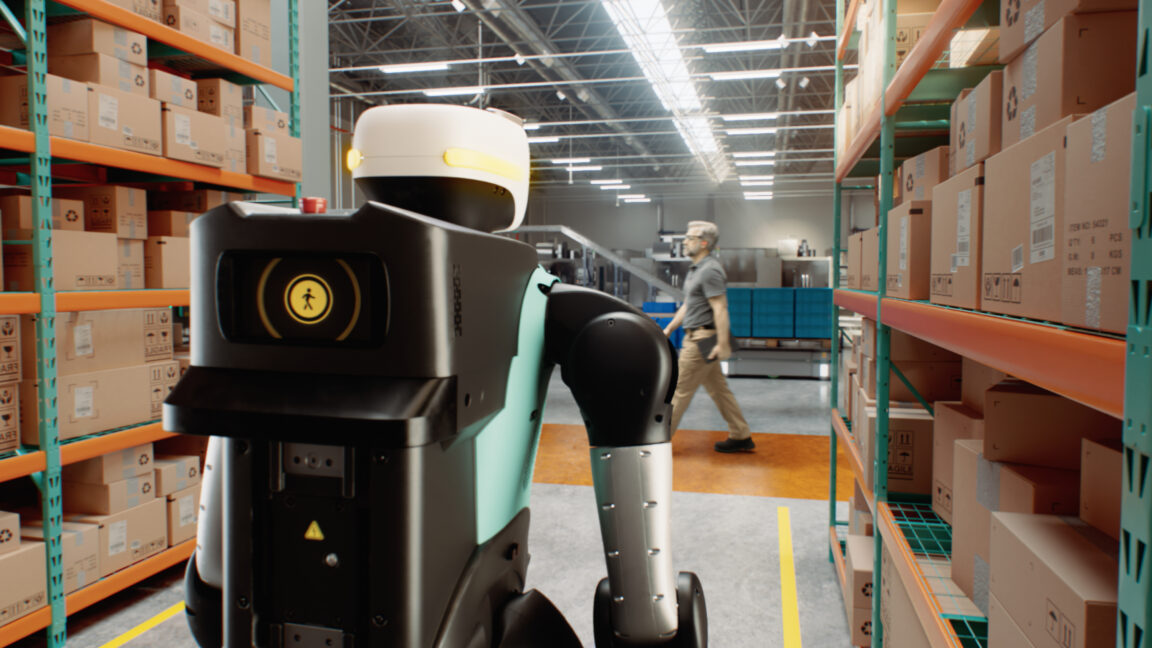
Agility Robotics’ Digit humanoid is using Halos to work around people. Nvidia says robotics companies are already using the system, while CEO Jensen Huang said physical AI generated nearly $10 billion in annual revenue for Nvidia in March 2026.
Why it matters
Nvidia is betting that the next obstacle for physical AI will not be intelligence or hardware. It will be proving that machines can fail safely when people are nearby.
That makes Halos more than another robotics software package. Nvidia’s IGX Thor module includes an independent processor for safety workloads. Halos monitors hardware and software components, separates safety-critical computing, and checks sensor data for corruption. Developers can also test robots in simulated environments and submit safety issues to Nvidia’s inspection lab program.
The important wrinkle is that “safe” cannot mean the same thing everywhere. A robot vacuum moving through a hallway faces a different risk from a forklift carrying heavy loads in a warehouse. Nvidia is therefore trying to build a programmable safety layer rather than one universal rulebook.
That could give robotics companies a ready-made foundation as they move from demonstrations toward real workplaces. But the commercial pitch still runs ahead of the public proof: the reporting provides no independent measure of safety performance, regulatory approval, deployment scale or pricing.
Comments
No comments yet.